
Immigrant students at CSI voice their support for Mamdani, but question the authenticity of his campaign and the feasibility of his proposed policies.
By: Sarah Ahmed
Although Cuomo has 40% polling lead on Staten Island, a borough known for its conservative leanings, CUNY CSI’s minority communities support Mamdani’s candidacy, even as some question how genuine his image is and whether his promises can be kept.
For many Muslim students at CSI, Mamdani’s immigrant background is a major selling point. And they are not alone: about 62% of foreign-born voters support Mamdani. The ethnically diverse college voter base is a microcosm and may be a harbinger of things to come.

While there are no publicly available statistics on the Muslim population at CSI, conversations with students and the campus’ Muslim Student Association suggest that they make up a visible and active part of campus life.
Sama Abunahla, a freshman in the MLS Program, pointed towards Mamdani’s everyman image. She cited how his campaign videos depict him not only interacting with fellow New Yorkers, but walking through local streets and taking the same trains as them.
“He’s relatable, he lives in an apartment, he pays rent himself, and I feel like he knows our struggle and can understand us,” said Abunahla. “People like Eric Adams are bathing in money and they’re not going to understand those problems.”
As a Palestinian student, Abunahla believes that affluent politicians do not have immigrants’ interests at heart, especially those of Palestinian descent. She remarked how affluent candidates like Cuomo “want to suck up to more powerful people,” while “Mamdani feels like one of us.”
Others aren’t as certain. Abubakr Raja, a Pakistani business major, doubts that Mamdani’s branding is authentic.
“I like him because he’s Muslim and I’m Muslim,” said Raja. “But I feel like he’s fake. He tries to act like he’s with the people most of the time and takes the bus, but I’m not even rich and I take my car and drive around.”
Evelyn, a first-generation Mexican American, pointed towards how campaign funding sources reflect a clear distinction in which groups are showing solidarity with which candidate.
“I think it shows what people can achieve when they come together for a cause,” said Evelyn. “Cuomo is funded by other billionaires that want him to stay in power because he’s easier to control.”
Mamdani’s campaign centers on tackling NYC’s affordability crisis. One point of contention amongst CSI students is the prospect of city-owned grocery stores.
Rather than corporate supermarkets that price gouge, municipal grocery stores will focus on keeping costs low, not turning profit. Mamdani proposes using city land to build stores exempt from property taxes that will purchase and sell products wholesale.
According to the U.S. Bureau of Labor Statistics, food-at-home prices in the New York–Newark–Jersey City area rose 3.5% over the past year since August 2024. While many students cited rising grocery prices as the largest factor placing financial strain on their families’ monthly budgets, some question whether Mamdani’s idea is too good to be true.
Edwardo, a computer science major born and raised in Mexico, addresses how a guaranteed low-price grocery seller could impact local businesses. He draws on a similar state-run supply initiative he witnessed during his childhood.
“Back in Mexico, they have this program that has their own food supply with chocolate, bread, and meat, but it really undercuts small businesses where people are trying to sell their own stuff,” said Edwardo. “And that money goes back to the country instead of staying in these little communities.”
Food for Well-Being is a government welfare program that purchases products from small-scale producers and redistributes them through state-run Wellness Stores. Although President Claudia Sheinbaum frames it as a “fair market” effort to help small producers reach consumers, critics argue it bypasses local merchants, limiting how much profit stays within communities.
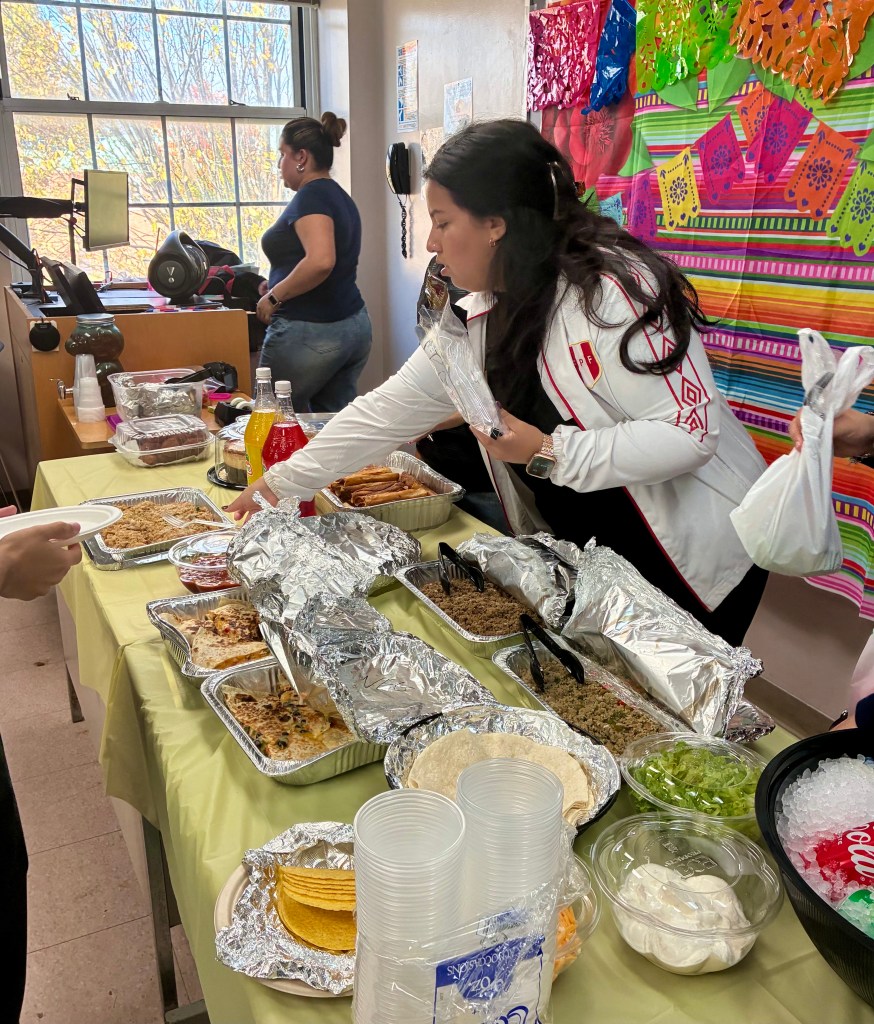
Edwardo, along with other students attending CSI’s Hispanic Heritage Month celebration, doubt the financial viability of Mamdani’s more ambitious campaign promises of fare-free buses and no-cost childcare.
Mamdani’s revenue plan involves taxing the wealthiest 1% of New Yorkers who earn more than $1 million a year at a flat 2% rate, which would raise about $4 billion. A sophomore from the Dominican Republic believes Mamdani will need to “flip the whole system upside down” to succeed.
He spoke with a fellow sophomore from Puerto Rico about how the wealthy often exploit tax loopholes, making it unlikely that anyone with a financial stake would support Mamdani, let alone remain in New York.
Both agreed that “there’s always a catch with these things.”
Evelyn believes that Mamdani’s bold attitude may not serve the city well in the long term. Although she doesn’t support Sliwa’s candidacy, she agrees with his suggested approach of negotiation above escalation.
“Sliwa had a good point that if you outright say Trump is fascist and you’re openly against him, Trump will attack NYC and cut federal funding, which means a lot of [Mamdani’s] policies won’t happen,” said Evelyn. “I feel like Mamdani’s antagonistic stance is good for the New Yorker because we resonate with that, but it can eventually bring harm to us.”
Mamdani’s revenue plan explains that the city budget depends on $10 billion in federal funding, while the state budget relies on $90 billion. He frames the tax plan as a way to fight back against Trump’s interference by funding programs that help the working class.
A Palestinian psych major explained how Mamdani’s policies would benefit the community she commutes from everyday: Bay Ridge.
“It’s such a big melting pot and so many people come from different backgrounds, especially financial backgrounds, and many don’t have secure jobs,” she said. “If someone like Mamdani is able to notice that people are working to live and [he] takes steps to fix that, I think it’ll definitely help the immigrants.”
As of 2023, the change in median gross rent in Bay Ridge/Dyker Heights outpaced the change in median household income by 10.4 percentage points. About one-third of renter households spent more than 50% of their household income on rent in 2023.
“The pattern of politicians has been very much not representative of the people who actually live in New York,” she said. “I think when there’s the same kind of person who grew up with the same backgrounds and means, they don’t care to notice the other side of New York that is carrying the city on their backs.”