
Shortcuts around campus reveal how students shape their daily environment and find common ground.
By: Aissatou Diallo and S. Manai
Commuting to CSI from Brooklyn, I never imagined I would have much in common with my fellow students, and yet, cutting through the trimmed hedges and beaten grass paths on campus, I’ve never felt more connected.
Every morning, CSI students arrive on campus disembarking crowded city buses and packed parking lots, with one goal in mind: getting to class on time. The one obstacle they all have in common are the outdated paths put in place by CSI, with no regard for the growing foot traffic on campus.
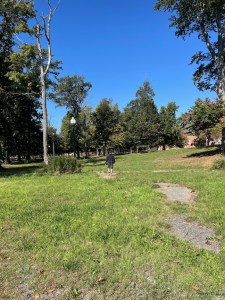
There are plenty of lessons to be learned at CSI, and taking shortcuts isn’t one of them, yet ironically, it is applied the most by students. If you’ve walked around campus, you’ve probably noticed the worn paths hewn through the grass, perhaps even walked through them unconsciously, or created your own. These are most commonly known as… desire paths.
These paths are not the result of meticulous planning by landscape architects or committees, but rather, are a product of decades of students who collectively decided to carve their own paths on campus out of convenience and necessity.
Depending on which class you have, the walk from point A to Point B can feel like an unnecessary maze of twists and turns. But the student-made dirt tracks weaving across CSI’s 204-acre lawn, telling us a different story, one of unity, practicality, and maybe a little rebellion.
Desire paths reveal something important about the student body; despite the different majors, backgrounds, and cultures, our footprints overlap. Each shortcut is a reminder that we’re all trying to pave our own paths, literally and figuratively.

As students, our schedules and the ways we move through campus are some of the few things we have control over. Yet the cracked and crowded walkways that converge at often confusing points are a challenge to the one thing we can’t afford to waste–our time.
So, why doesn’t CSI make it more convenient for us by creating feasible paths to help students navigate the campus more easily? Full-time resident students pay nearly $4,000 a semester, and non-residents pay $620 per credit hour. The cost of tuition may be out of our hands, but time certainly isn’t.
If tuition represents an investment in our education, then the state of the campus should mirror that investment and design the paths to be more accessible and convenient with the current and future student body in mind.
That is why these paths are vital. They don’t just represent shortcuts in the grass; they symbolize the small ways students can shape their environment and, in turn, each other.

Sometimes, the truest route forward is a route unpaved.
