
A student builds his craft through feedback, film competitions, and a growing focus on stories that reach far beyond the classroom.
By: Joseph Lonardo
The late afternoon sun hit the center of campus as students crossed the walk between classes. In a quiet spot near the benches, Michael Kitchens balanced a worn copy of “Frankenstein” on one arm and scrolled through notes for his next project.
It was one of those small breaks between classes when he found time to study, edit, and think about where his writing will take him next.

“The one thing CSI did best for me was the impact of receiving feedback,” said Kitchens. “It helped me shape my work in better ways and think about things I hadn’t before.”
Kitchens writes across several forms, including screenplays, poetry, and fiction. He treats each as a chance to explore new ideas and understand what makes a story connect with people. Much of his writing time is spent revising lines, trimming dialogue, and testing how scenes play out before he moves to the next idea.
He often spends late nights refining his work and rewriting his scenes, adjusting tone and rhythm until each line feels complete. These hours are when his best ideas appear and when he feels most connected to the story he is building. Writing has become a daily practice that shapes his focus.
His work has already gained attention outside CSI. He submitted his script Back of My Mind to the Oniros Film Awards and his piece All Is Fair to the New York Metropolitan Screenwriting Competition. Both earned recognition, including finalist awards that gave him motivation to keep improving and reach new audiences.
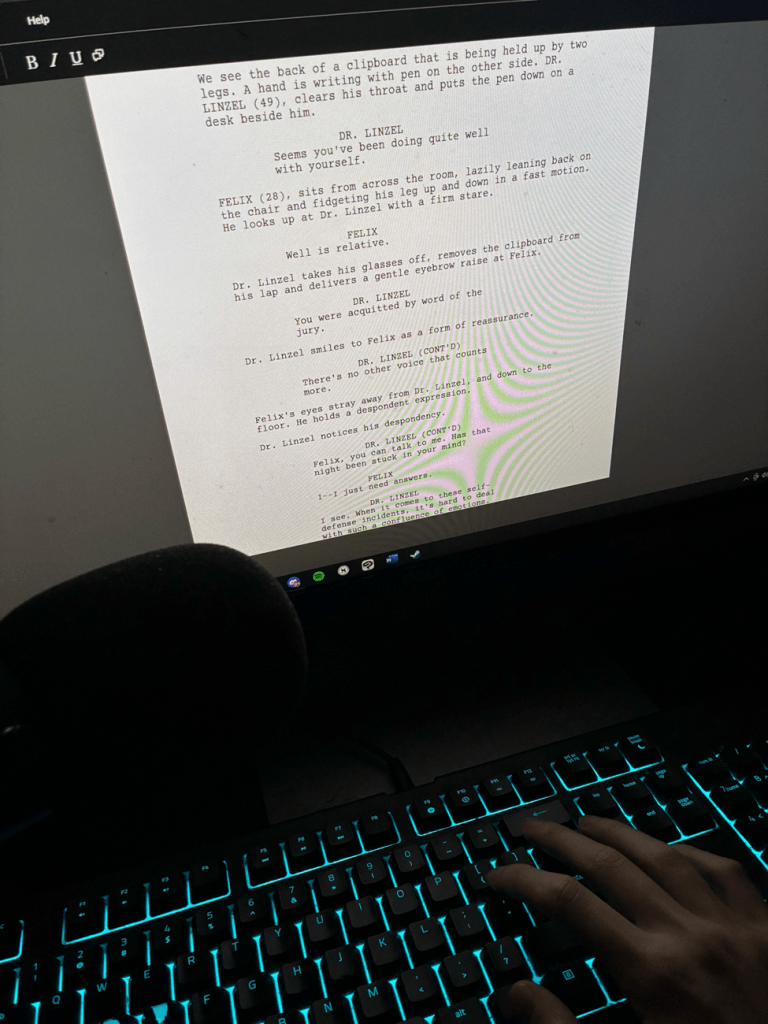
“I entered my scripts into two film festivals and earned finalist awards,” said Kitchens. “It showed me that the effort I put in is starting to reach people.”
Kitchens said that courses such as Creative Fiction Workshop, Coming of Age Narratives, and Introduction to Screenwriting helped him build confidence. The steady flow of feedback in those classes pushed him to look at his work from other perspectives and revise with purpose. When he joined Craft of Playwriting with Professor Lee Papa, he began to see how dialogue and structure could carry meaning beyond the written page.
“The professor asks a student to see their work from another perspective and develop ideas in directions they might not expect,” said Papa. “That kind of push often leads to new and exciting ways of approaching what they write.”

Recently, Kitchens has been studying fantasy and how to balance imagination with realism. He reads authors such as Mary Shelley, Haruki Murakami, Osamu Dazai, and John Steinbeck to see how each creates emotion through quiet but precise details. Those writers have helped him refine his tone and experiment with how much fantasy he can add without losing the truth of his characters.
Outside of class, Kitchens writes scripts for YouTube commentary videos on shows like “Arcane” and “Better Call Saul.” Every script is planned and written before recording, giving him a way to practice his pacing and focus. Each project keeps him consistent and reminds him that strong writing always depends on time, discipline, and patience.
In the near future, Kitchens hopes to pitch his screenplays and novel projects to agents, producers, and companies that can help share his work on a larger scale. He wants his stories to reach beyond CSI while still carrying the lessons that shaped him as a writer. Each new idea is another chance to test his skills and see how far he can take his writing next.
“I never want to stop writing,” said Kitchens. “It’s what gives me direction and keeps me grounded when everything else feels uncertain.”

