
Due to many factors,location,presentation and approach CSI STI testing day led to poor attendance and impact .
By: Demori Louis
The low participation at the STI testing day event raised concerns about student sexual health not being successfully addressed. The event planning was seen as a misstep by both students and organizers. The promotions were not effective, and the taboo around talking about sex created a challenge in attracting both participants and spectators.

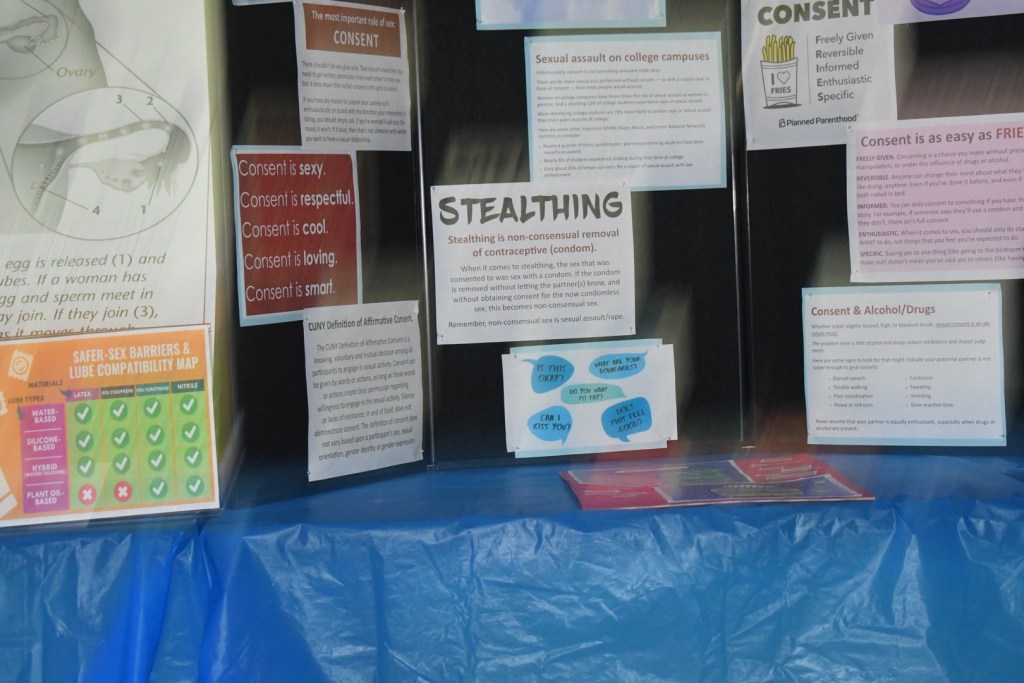
The STI testing was held in 1C, the campus cafeteria and health office. Most students shuffled past the informational boards and went straight for their food. The student staff, including Rahaman Yuldashol, were aware of the predicament they faced.
“It is a societal issue, and it should be discussed,” Yuldashol said. “Unfortunately, this is an issue students are unaware of and ashamed to learn about.”
Yuldashol’s point was supported by a study from Washington and Lee University. According to the research, one in every four college students has an STI. The most common infections are gonorrhea, chlamydia, syphilis, and trichomoniasis.
This data comes from the National Library of Medicine, which tracks infection rates across campuses. The statistics underscore the importance of awareness and access to health resources. Yet, many students at CSI didn’t engage with the opportunity provided.
CSI’s enrollment for fall 2023 was 10,736 students, according to U.S. News. If one in four students has an STI, an estimated 2,684 may be infected. That makes the turnout of 17 for the event even more alarming.
Students said they were intimidated by the setup of the testing booth in a public area. The idea of getting tested or even talking about sexual health near their peers felt invasive. One student walking past the booth voiced his hesitation.

James Rutman, a student at CSI, explained why he didn’t attend the event.
“I’d rather go to my local doctor if I had any personal health issues,” Rutman said. “There’s no way I’d get tested in the middle of the café. What if someone saw me? It’s a no-brainer. On a Wednesday in a packed cafeteria, it’s just too awkward.”
Rutman, like many others, pointed to the location and timing as major turn offs. The test was held on Wednesday, March 12, from 10 a.m. to 2 p.m. Students were eating, relaxing, or heading to class—not thinking about health screenings.
Event staff also reflected on the challenges. Flyers, posters, and a short survey were used to promote the event, but few students seemed to notice. One nursing student helping with outreach shared her concerns.
Arianna Tucker, a student majoring in nursing, said the approach missed the mark.
“I see what we’re trying to do, but students don’t feel comfortable talking about their sex life like this,” Tucker said. “This is a bad approach, and it doesn’t meet them where they are. A table and a poster don’t reach students who have class and jobs. They did not connect.”
She added that most students skim over campus flyers and ignore emails. According to U.S. News, only 4% of CSI students live on campus. That means 96% commute, making in-person engagement even harder.
Beyond planning, deeper issues exist. Many pointed to a cultural stigma around sexual health, especially in Staten Island. One school leader highlighted the difficulty of addressing that problem.
Janine Scotto, interim director of CSI Health and Wellness, spoke about the barriers students face.
“You know Staten Island has four hospitals. It is very possible to run into someone you know,” Scotto said. “This is an issue we at CSI are trying to solve. The taboo is still there with this topic. We are heavily underfunded and stretched thin—but we’re trying.”
