
Can Chado unite us all?
By: Sarah Ahmed
On June 27, CSI students crossed the street from the Kinugasa campus of Ritsumeikan University to the former house of the artist Insho Domoto. They weren’t there to visit the late artist’s museum as part of their study abroad program in Kyoto, but to learn about a different aspect of Japanese culture. Sitting criss-crossed in a circle on tatami mats, they joined members of the Tsukimitei tea house, who began setting down bowls for a tea ceremony.
“It’s the appreciation of each individual moment, the idea of Ichi-go ichi-e, one-time, one-chance,” said Michael Hardy, an instructor of Japanese tea ceremony. “Everything to me kind of comes back around to this concept that every individual moment is once in a lifetime, that everything changes, everything has a season and basically very little permanence.”
Chado, although commonly seen as a traditional Japanese tea ceremony, is also considered a disciplined way of life. The prescribed actions performed during the ceremony reflect the spirit of Chado, one which emphasizes noticing and appreciating the meaning in everyday moments. Hardy believes it also has another potential benefit: world peace.
Or at least interconnection. He pointed towards the history of tea ceremonies held by warlords and local rulers during diplomatic meetings in the Warring States Period.
“There’s a — not humbling as in shaming, but like a moment in the tea space that lets you throw away all these roles, responsibilities, rankings, and just kind of connect with another person,” said Hardy. “I think that they were able to get to this much more level-headed and equal-footed place when they started their negotiations, and rather than simply trying to do the best for themselves alone, they had to think about the other person as a person.”
Hardy directed students to sit beside each other and explained the customs of a traditional ceremony, including the manners expressed between the host and guest, as well as among the guests themselves. First, you place the bowl of tea between yourself and the next guest and acknowledge that you are drinking before them by saying Osaki ni (“excuse me for going before you”), to which the other replies Dōzo (“please go ahead”).
Next, you place the bowl in front of you, bow to the host, and say O-temae chōdai itashimasu (“thank you for the tea”). Then, you take the bowl in your hand and pause to turn it, appreciating its craftsmanship before bowing your head once more to express thanks to the artisan. The final act of hospitality and respect is to ensure that you turn the bowl to its “best side,” presenting its design outward to others, not yourself.

“I really liked how the Chado instructor encouraged us to not use our phones because it felt like an intimate moment with my peers where no one was recording anything,” said Vanessa Llamas, a Queens College senior. “Even if some people were nervous, they began to grow more comfortable talking with each other while embracing the culture and it really felt like we bridged the gap between us early in the program.”
In the West, modern businesses like Starbucks have sought ways to revive a sense of connection between server and customer. In early 2025, under CEO Brian Niccol’s “Back to Starbucks” strategy to restore stores’ welcoming atmosphere, Starbucks implemented a policy to have baristas write personalized notes on customer’s cups. Yet the move drew backlash from baristas who saw it as an added burden during already hectic order rushes, and customers who questioned the authenticity of the gesture.
The decrease in human connection is not merely confined to coffeehouse walls. Research has correlated increasing internet and social media usage to higher rates of isolation and loneliness. According to Making Caring Common, a nationally representative survey of adults conducted in May 2024 suggested that 21% of adults in the U.S. reported feeling lonely, and of these adults, 65% felt fundamentally disconnected from others or the world.
“According to our former grandmaster, it’s not ultimately about using the green tea or the tea whisk, but it’s just more about trying to create that atmosphere of interconnection between server and servee, host and guest, that we just find common human shared ground,” said Hardy. “And it’s not that difficult to do, because we share experiences as people—in our surroundings, in our general needs and desires—so if we just dig a little under the surface, we have so much that we can communicate.”
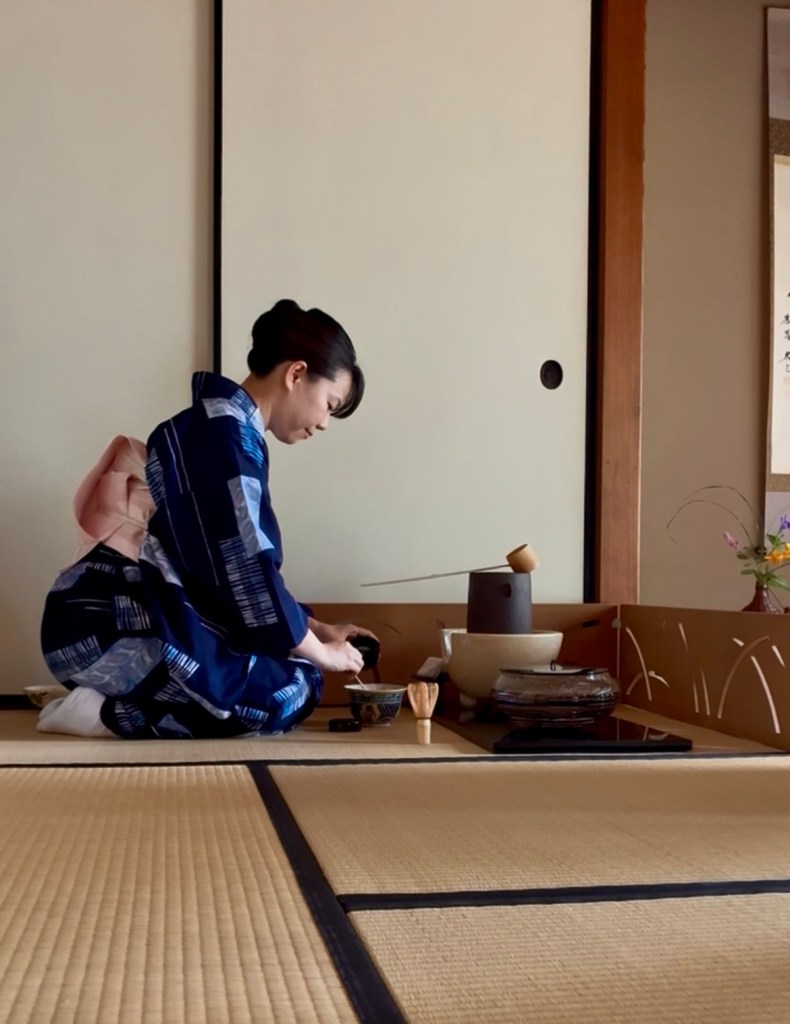
While international popularity of matcha has skyrocketed in recent years, the wabi-cha style of tea ceremony was popularized in Japan by Sen no Rikyū back during the sixteenth century. The lifestyle emphasizes four main ideals: Wa (harmony) with one another and with nature; Kei (respect) for one another and an acknowledgment of our mutual dependence; Sei (purity) in both the external physical sense and the interior spiritual sense; and Jaku (tranquility) within a steady and serene state of mind.
Part of Hardy’s presentation for students included common misconceptions about Japanese tea ceremonies. One was that it was solely an Eastern tradition, but Hardy guided the students’ attention to their surroundings, particularly to the Tokonoma, a small alcove within the tea room. He explained how he chose the seasonal decorations of a flower arrangement and an ice cube perched on the alcove in order to appeal to students’ tactile senses in the summer season. An essential aspect of the way of tea is the Zen-inspired concept of appreciating the subtle details we miss in our daily lives as a source of fulfillment.
“This extension of your consciousness beyond yourself and in the tea space is easily trained because you become much more aware of yourself in that space, as every little detail around just starts to come forward,” said Hardy. “Part of the culture is these moments of limitation, where your mind starts going a little bit crazy wanting something to do and if you could harness that, then it starts reaching and taking in all these details that you would normally miss if you’re distracted.”

