
CSI’s “World on Fire” lecture series invites Melissa Aronczyk to speak about climate change’s “branding problem”
By: Sarah Ahmed
Microsoft’s greenhouse gas emissions have increased 23.4 percent compared to its 2020 baseline – the same year the tech giant announced its goal to become carbon negative by 2030. The company’s 2025 Environmental Sustainability Report attributes this increase to the expansion of AI data centers during the 2024 fiscal year.
Some might consider it ironic that Microsoft was a session partner at NYC Climate Week, the largest annual event addressing climate change. Melissa Aronczyk, a professor of Media Studies at Rutgers University, considers it a branding problem.
“Microsoft wants to make sure we are still associating their brand with climate action and sustainability in our minds,” said Aronczyk. “They want us to be thinking ‘Microsoft and sustainability’, not ‘Microsoft and climate disaster.’”

On September 26th, Aronczyk spoke to CSI students about how major carbon-emitters brand themselves as environmentally conscious. She explains how many electric energy and fossil fuel companies hire public relations firms to associate their brand with sustainability and clean energy, as well as sponsor events like Climate Week.
The week-long gathering hosted by the Climate Group from September 21 to 28 drew international attendees from activist and nonprofit organizations, governments, and businesses. Aronczyk noted the presence of multiple electric energy and tech corporations on the event’s sponsor and partner list. She also pointed out the opening ceremony partner: McKinsey Sustainability, a client-service platform of McKinsey & Company.
A report from the New York Times found that McKinsey & Company has advised 43 of the 100 biggest corporate environmental polluters including Exxon Mobil, BP, and Gazprom. D.J. Carella, a spokesman for McKinsey, stated that reducing emissions “requires engaging with high-emitting sectors to help them transition.” According to Mordor Intelligence, the global climate change consulting market is projected to grow from $6.13 billion in 2025 to $10.23 billion by 2030.
But Aronczyk believes that greenwashing polluters can complicate the discourse surrounding climate change and prevent the public from conceptualizing a collective response. She puts it in a historical perspective.
While Edison International is partnering with Climate Group in 2025, the company was working with the Information Council for the Environment to promote climate change denial 40 years ago. In the 1980s, fossil fuel companies placed their efforts in launching advertising campaigns in print and media to fuel skepticism about scientific consensus. These companies also aimed to encourage more entities in the electric utility industry to join the campaign and further sow doubt about global warming.
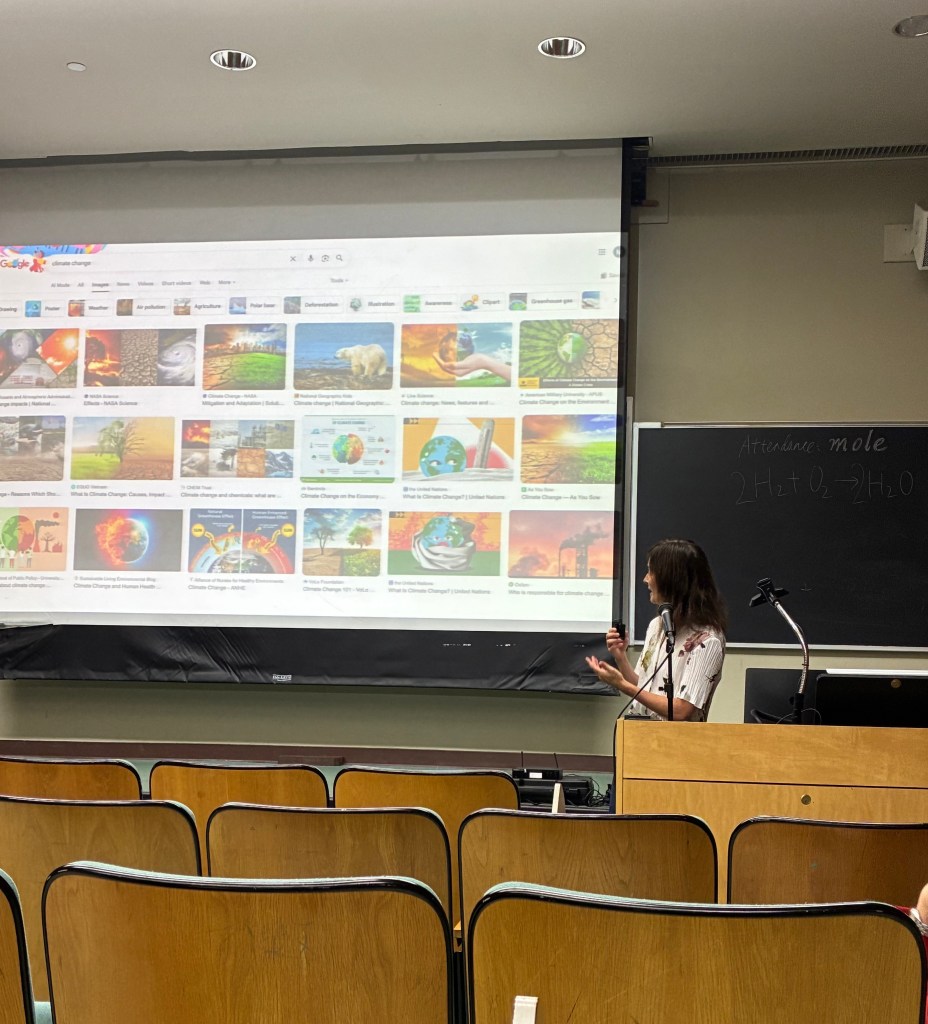
“This is an, at least, 40 year campaign by those who do not want us to imagine the reality of climate change,” said Aronczyk. “If we let these companies do the imagining for us, we are going to get a picture in our minds of climate change that may not be the picture we need…[to] work together to respond to climate change.”
When one CSI student brought up the topic of how people may be aware of climate change but are unwilling to do anything about it, Aronczyk explained the nuances of individual responsibility. She points to how many companies launched campaigns that encouraged the public to focus on recycling.
Aronczyk believes that while individual effort is helpful, what people do at an individual scale will never compare to the positive change that would occur if companies changed their production process and innovated less-environmentally damaging materials.
Studies show that 56 companies were responsible for 50% of the world’s plastic pollution from 2018 to 2022. The Carbon Majors Database reports that 57 corporate and state-owned fossil fuel and cement producers are responsible for 80% of all global carbon dioxide emissions since the 2016 signing of the Paris Climate agreement.
Aronczyk argues that if individual action is used as a deflection by companies to continue their operations that pollute the planet, then it restricts our ability to create a sustainable future. One action she suggests we take is to hold brands accountable.
“We should really talk about difficult topics through a lens of multiple academic disciplines,” said Dr. Sarolta Takács, Dean of the Humanities and Social Sciences at CSI and organizer of the “World on Fire” lecture series. “I hope that more CSI students come, ask questions, and join the conversation.”
Aronczyk opened her presentation by discussing how climate change has its own branding problem. When she asked students what images come to mind when they think of climate change, they mentioned melting ice, wildfires, and gas plumes. A quick Google search for the term produced similar images, leading Aronczyk to question how these recurring visuals shape public perceptions of climate change through emotions like fear, anxiety, and depression.

The branding of climate change as an existential issue can have negative effects on mental health. The American Psychological Association and ecoAmerica define “eco-anxiety” as a “chronic fear of environmental doom.”
A recent APA Healthy Minds poll found that 55% of adults believe climate change is impacting Americans’ mental health, with 35% reporting that they personally worry about climate change on a weekly basis.
While the negative emotions associated with climate change can cause mental distress, Aronczyk warns of allowing pessimism to encourage inaction. She explained how we should perceive climate change as a part of our generation’s reality and collectively imagine a way to live with this reality.
“If we throw our hands up in the air and give up, then that doom that they’re predicting is going to come,” said Donna Scimeca, a CORE 100 professor who encouraged her students to attend the lecture. “I think humans can’t give up; we can’t afford the luxury of giving up.”

