
Preparing for the Unforeseen
By: Keanu Agard
With the epidemic of school shootings demanding an unprecedented need for medical knowledge, CSI’s Health and Wellness Center, is hosting a variety of vital events to equip students with life-saving skills.
As of October 27th, there have been 64 mass school shootings in the United States in the year 2025. According to CNN, thirty-seven of those shootings occurred on college campuses nationwide, resulting in approximately 26 deaths and over 100 injuries.

To address this ongoing issue, the American College of Surgeons’ Stop the Bleed initiative was introduced to the College of Staten Island by Janine Scotto, director of the Health and Wellness Center, and Julia Glauboch, BSN, RN, from Staten Island University Hospital. The goal is to educate students on how to stop bleeding during catastrophic events.
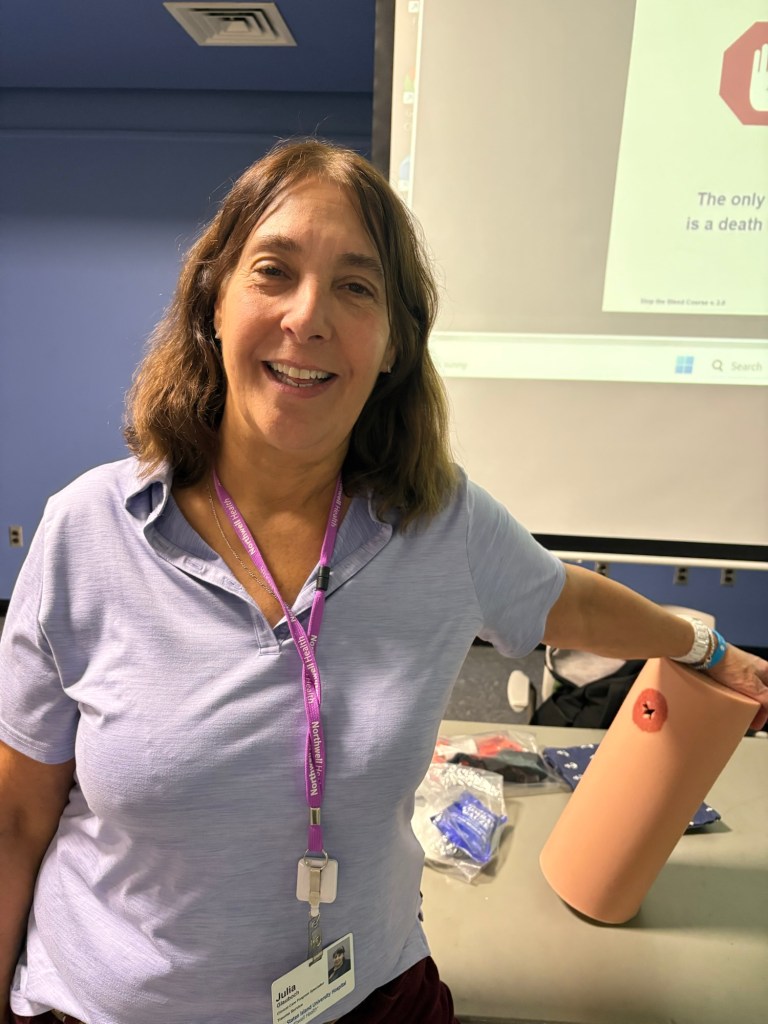
Division of Trauma, Injury Prevention & Education.
“This is a great way for students to learn life saving skills,” said Scotto. “Despite the event being mainly attended by students with interests in Health Sciences, I think that this type of knowledge is great for every student to have and even the general population to know.”
Students participated in practical exercises such as assessing bodily injuries, applying and making improvised tourniquets, wound packing, applying pressure to various areas of the body and the ABC’s of bleeding control.

During training, the body was sectioned into three color coordinated categories for treatment: blue areas (arms and legs) where tourniquets are recommended, green “junction areas” (neck, armpits, and groins) where tourniquets should be placed above the injury, and the orange cavity (chest to torso) where wound packing is preferred. It is advised to not remove the tourniquet after it’s placed.
“It’s a great initiative for Staten Island University to help raise awareness to these current issues,” said Rahman Yuldashov. “I think that this is great training for many students like myself and thankfully we do have many more training sessions like this available at CSI such as CPR and Narcan.”
CSI’s Campus Police and Wellness Center are both equipped with Stop the Bleed kits and can be accessed when needed.
Want to become a lifesaver? Get certified today by visiting the American College of Surgeons website to find training sessions near you or stop by the Health and Wellness Center located in 1C-112 to ask questions about this life-saving initiative.
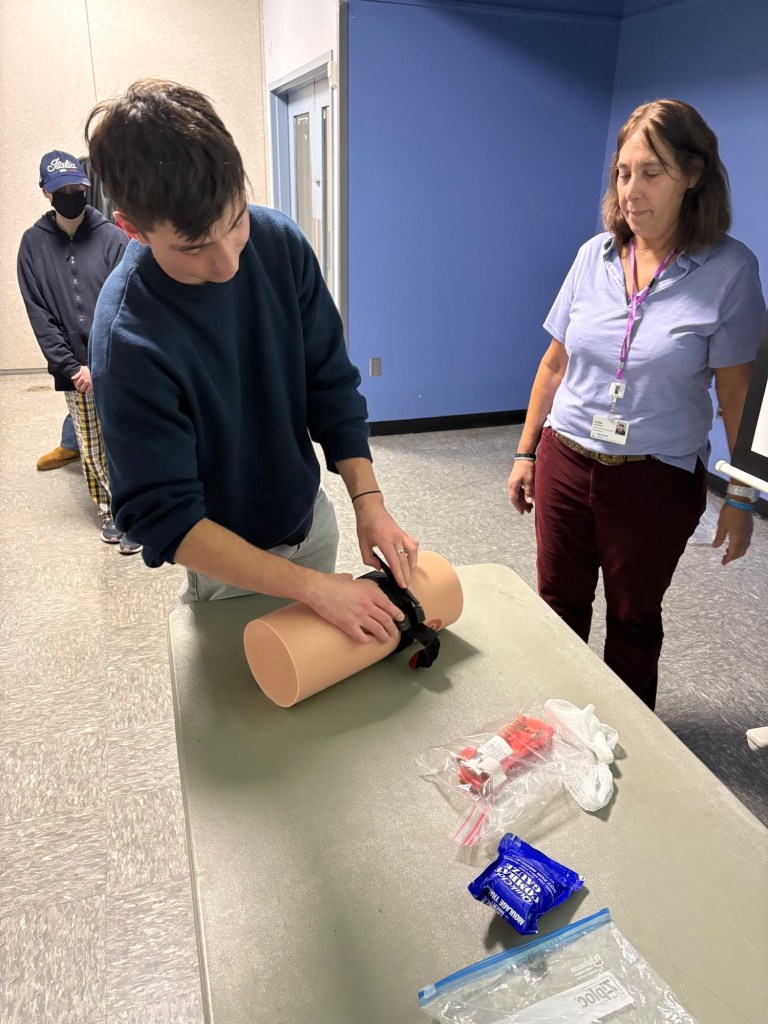
One must always remember these ABC’s that represents the steps to bleeding control.
A stands for “Alert 911.”If you are unable to do so, have someone call on your behalf. Be aware of your location and follow the instructions provided by the 911 operator.
B stands for “Bleeding and Breathing.” Inspect the body for open wounds, continuous large-volume bleeding, and pooling of blood, then ensure that the person is breathing. If the person is not breathing , CPR can be administered.
C stands for “Compress.” Place a tourniquet 2-3 inches above the wound. Then apply direct pressure to the wound as needed.
For large, deep wounds, superficial pressure is not effective. In this instance, wound packing is recommended. Use just enough gauze or cloth to pack tightly into the wound to stop the bleeding.
Follow up by applying pressure. Keep applying pressure on the wound until help arrives.
In instances where gloves aren’t available, ensure that you wash your hands with soap and warm water and alert the paramedics on the scene if you come in contact with blood.
If you are unable to have a tourniquet at your disposal, improvise. The use of a belt, tie, shoe lace, and a piece of cloth paired with a butter knife, pen, or sturdy object can be used to tighten and apply direct pressure.

“In life and death situations, when it comes to saving a person’s life or preserving a limb,” said Glauboch. “It’s life over limb always, no matter what we put the person’s life first.”
