
Why are people suddenly obsessed with collecting buttons and why are they posting their jarful escapades to Charlie XCX’s track 365?
By: Sarah Ahmed
The phrase, “hey so it actually only has to make sense to me for me to do it and I don’t feel like explaining it to anyone else,” has become the pillar of many netizen’s 2026 rebrands. But why are people also buying 365 buttons to ring in the New Year?
It can all be traced back to a Tiktok comments section. On Dec. 21, 2025, user Abbieabbieabbie0 posted a video to a “Devil Wears Prada” audio while wearing a face mask and scrolling through Pinterest.
The sound is Miranda Priestly, a stern fashion magazine editor, shooting down ideas suggested by her employees for their April issue. Many Tiktokers used the audio to joke about their strict image rebrands in all stereotypical girlboss fashion.
Some women are sharing the moodboards they created on Pinterest to visualize their new and improved 2026 selves. Others are posting powerpoint presentations about behaviors they are leaving behind in 2025.
One user in Abbie’s comments section had a different idea, albeit poorly explained.
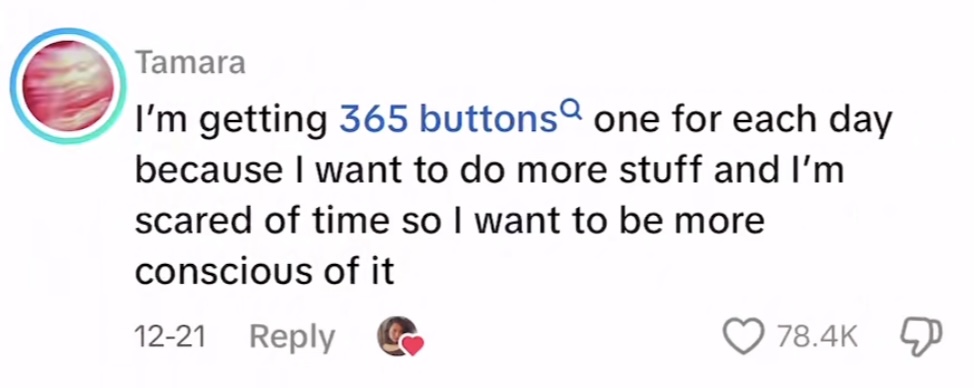
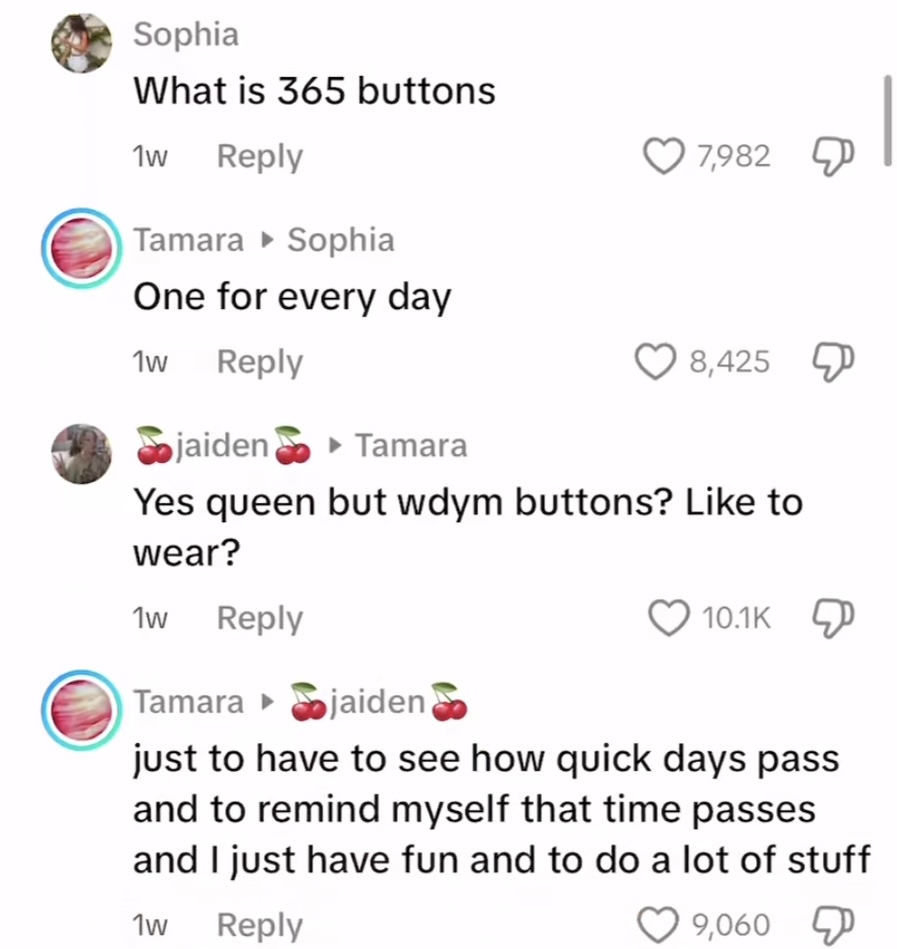
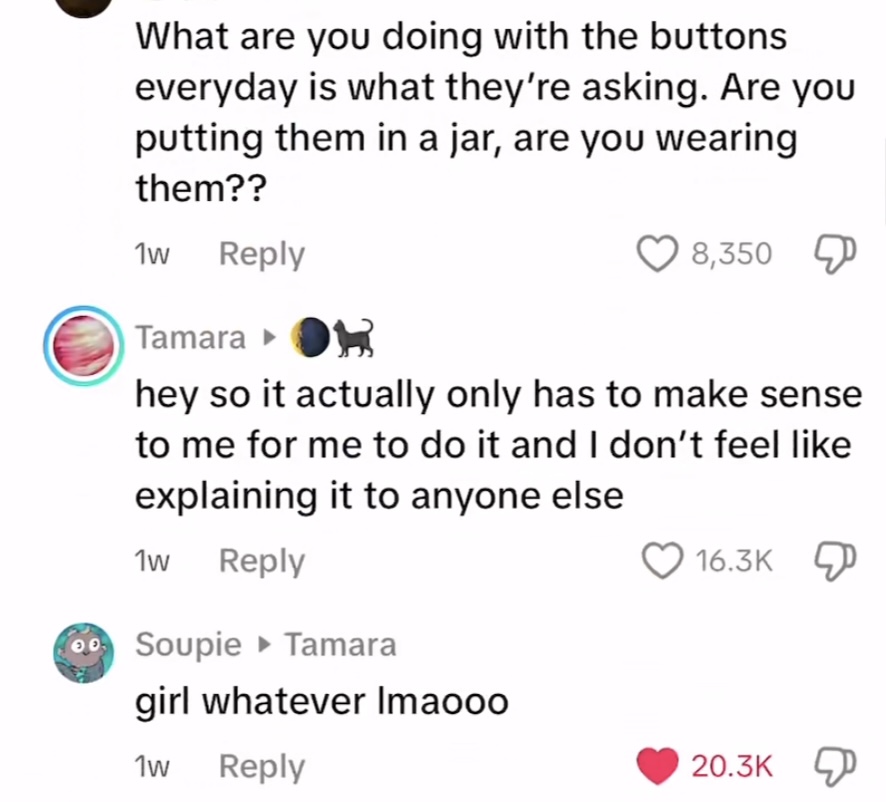
Within a week, the comment exchange went viral and #365buttons was trending. The Philadelphia Eagles posted a Tiktok slamming a container filled with branded buttons on the floor with the caption, “Alright Tamara, now what?” Thousands of users referenced the niche internet joke and posted videos showing off their colorful purchases.
The most accepted interpretation of Tamara’s tradition is to buy two jars, fill one with 365 buttons, and transfer one button to the other jar each day. Although there is a deleted comment from Tamara stating she “just want[s] to carry around a button everyday.”
What is arguably more culturally significant than the button craze is Tamara’s decisive words. Many began reposting her comment, posting videos about how iconic she is, and creating thought pieces about how this is the energy we need to internalize in the new year.
But why is there such a sweeping embrace of Tamara’s dismissive attitude?
I, and many others, found it refreshing. Finally, here was someone who did not feel the need to give into what others asked of them.
In the post-modern age of the internet, rife with an unending demand for context, you must ensure that anyone who encounters your message understands exactly what you mean. You must account for every angle, address every misinterpretation, and sacrifice your sanity to appease the internet’s disposition to whataboutism.
The “What About Me Effect” was first coined in Sept. 2023 by content creator Sarah Lockwood.
“[It’s] when someone sees something that doesn’t really pertain to them, or they can’t fully relate to, and they find a way to make it about them — or try to seek out certain accommodations for their very nuanced, personalized situation, instead of recognizing that maybe they’re just not the target audience for that thing,” said Lockwood.
She cited an example of what happened when another Tiktok user, Vibingranolamom, posted a high-iron bean soup recipe for people struggling with anemia. Lockwood noticed how many users commented that they disliked beans or asked about substitutions.
Some might chalk this up to a lack of common sense, but Lockwood attributes the phenomenon to the individualistic culture rampant in the U.S.
I’d argue it’s a symptom of algorithm-defined social media. There is a new social contract that governs internet interactions, and it is defined by the self-centeredness of a chronically online culture.
To scroll on a video platform, we willfully offer up information about our interests, viewing habits, and data to companies like Meta and ByteDance. In exchange, we expect an accurate, personalized viewing experience.
But what happens when a video breaks the illusion? Some feel the urge to engage with content not made for them. Creators are then expected to acknowledge or validate everyone’s thoughts, even if they’re unrelated or pointless.
The same entitlement people implicitly hold towards content creators pervades the conversations we have online. Tamara chose to deviate from that norm, and refused to provide the context others believed they were owed.
It’s almost ironic that Tamara’s comment was posted under a video for a trend that is overwhelmingly performative. To be fair, posts about New Year’s resolutions surface each January like clockwork. Yet lately there has been a shift in what healthy goals signify.
Self-destructive behaviors like bedrotting, doomscrolling, and self-isolating have increased in tandem with the country’s growing mental health crisis. In response, self-care is now a marker of stability, and one that guarantees engagement.
While many still obsess over watching wealthy celebrities’ DITL vlogs, content creators who are “disgustingly educated,” productive, and physically active are trending. So now we circle back to the age-old question: is posting your life and achievements online a form of performance or inspiration?
The concept of a “rebrand” already implies you are projecting a new outward appearance. Even if your moodboards on Pinterest are private, you are actively selecting images to fit the aesthetics you want to embody in 2026.
Many questioned why Tamara commented at all if she wasn’t open to explaining herself.
What could sharing your personal custom on a public platform while refusing to let others understand it be, if not the pinnacle of authenticity?

