
Home life has been anything but typical for CSI student Javonn Isler. However, the 24 year old shows that communication goes far beyond sound.
By: Isaiah Latif
After a long day at school, Javonn Isler returns home to complete silence, despite the house being full. The television is on, but no sound is coming out of it. He sees both parents sitting on the couch watching the news with subtitles.
The paradigm of Isler’s family is a unique one, but he is accustomed to it. Both of his parents have been deaf since he was a child, and he communicates with them almost entirely through American Sign Language (ASL).

When he was a kid, Isler was bullied for the disabilities of his parents, and for most of his life he felt insecure using ASL. He felt ashamed, and only used ASL in front of family and very close friends.
“People didn’t understand my situation, it was hard,” said Isler. “Kids used to look at how my parents communicated and they laughed.”
Throughout his life, Isler has had to serve as an interpreter for his parents. Whether it be parent-teacher conferences or random interactions throughout the day, he is always a bridge between his parents and the rest of the world.
While helping his parents felt rewarding, oftentimes it was exhausting to be constantly relied on.
This role came with a lot of pressure. He had to make sure to relay information in an accurate and precise manner, and it’s something that not many young people are used to.
He believes that being a translator from such a young age taught him responsibility and maturity that most kids his age didn’t have. Isler says he “felt like an adult” in most situations when he was still a kid.
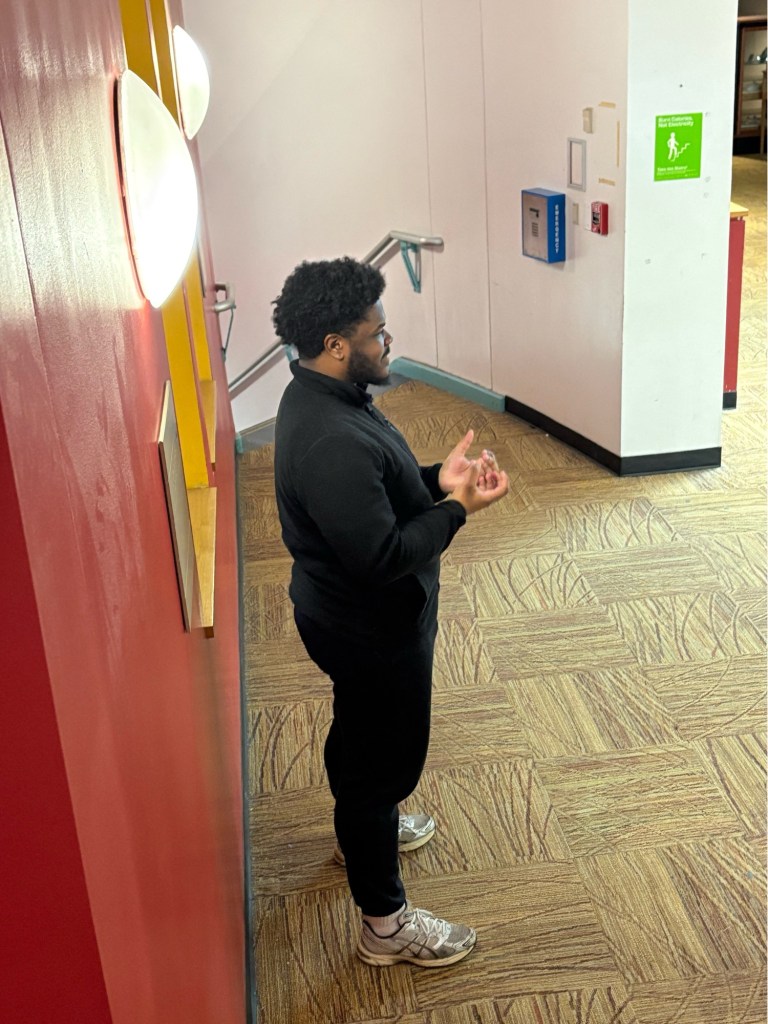
It was challenging to switch between ASL and English in day-to-day interactions. He would accidentally use ASL in situations where he needed to speak verbally and vice versa. However, after much practice it is now second nature.
While Isler acknowledges the advantages he’s been given through his circumstances, he also wishes he didn’t have to take on such a large and dependent role.
“I always thought about how life would go if they weren’t deaf,” said Isler. “Would it be easier? Would it be harder?”
Despite the challenges, Isler says that these experiences helped him develop empathy and strong communication skills. He commonly uses ASL to help deaf people outside of home, specifically on the basketball courts where he spends his free time.
When he plays on the courts in his hometown of Brooklyn, he relays the score in both English and in ASL for any deaf players. He’s established himself as a communication hub for the deaf players and the verbal players, often directing team strategy in both languages.
Isler is currently working on joining the ASL club at CSI, and he works to learn new words in ASL every day. He says that the language is ever changing, and that there are always new ways to say things. He claims he learned the “OG” ASL, and that the new-school ASL is something he’s trying to learn.
His perspective has changed a lot since he was a kid, and he is no longer ashamed of his capabilities in ASL, or the way he communicates with his parents.
He has transformed his life and the lives of others through ASL. He takes pride in his capabilities and helps whoever he can.
He says that he would be open to being a professional interpreter in the future, and is pursuing a degree in communications at CSI to further his capabilities.
“Another day in the life using my super power to help people,” said Isler. “I wouldn’t change it for the world, ASL is a powerful language.”

