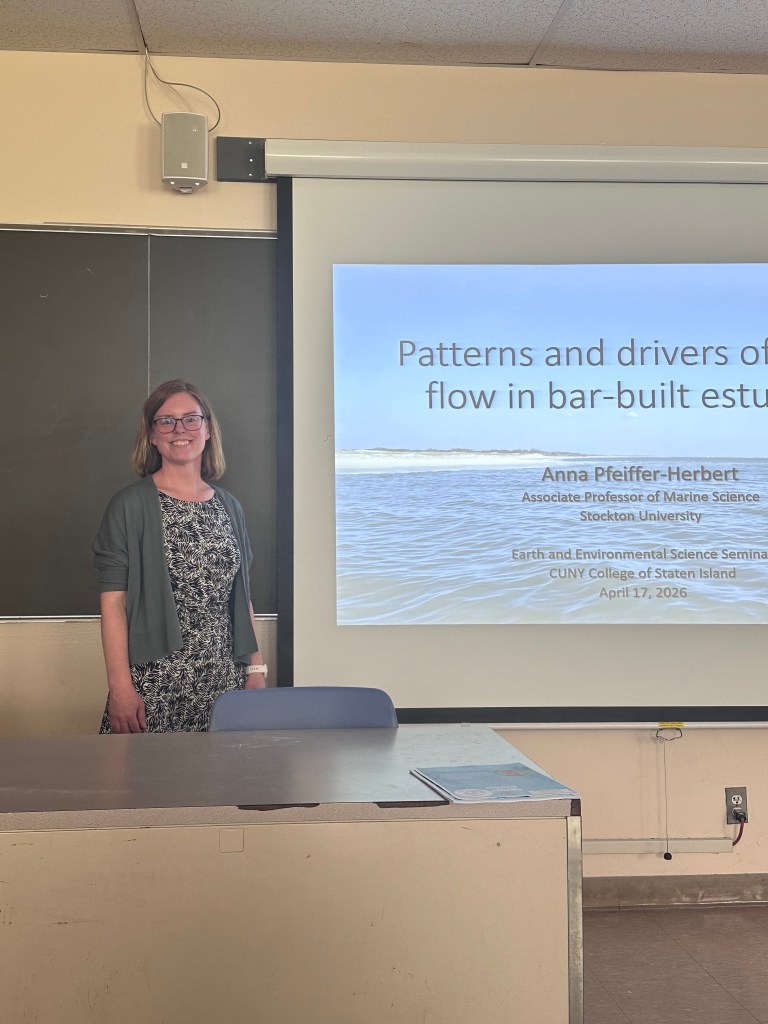
Stockton University Professor Anna Pfeiffer-Herbert presents research examining the impact of water on the barrier constructed in the New Jersey cross-section.
By: Emma Miller
Most people see a sandbar as a place to tan; Anna Pfeiffer-Herbert sees a battlefield. At 2:30 pm on a quiet Thursday afternoon, the Stockton University associate professor stood before a room of students to reveal the invisible war of currents and chemistry inside bar-built estuarine landscapes—ecosystems where freshwater is trapped by shifting sand walls. These unsteady conditions impact New Jersey’s coasts.
“I get much more excited about what’s happening within the water itself, ” said Pfeiffer-Herbert. “Now, I live on the New Jersey shore, where we’ve got lots of barrier island systems.”
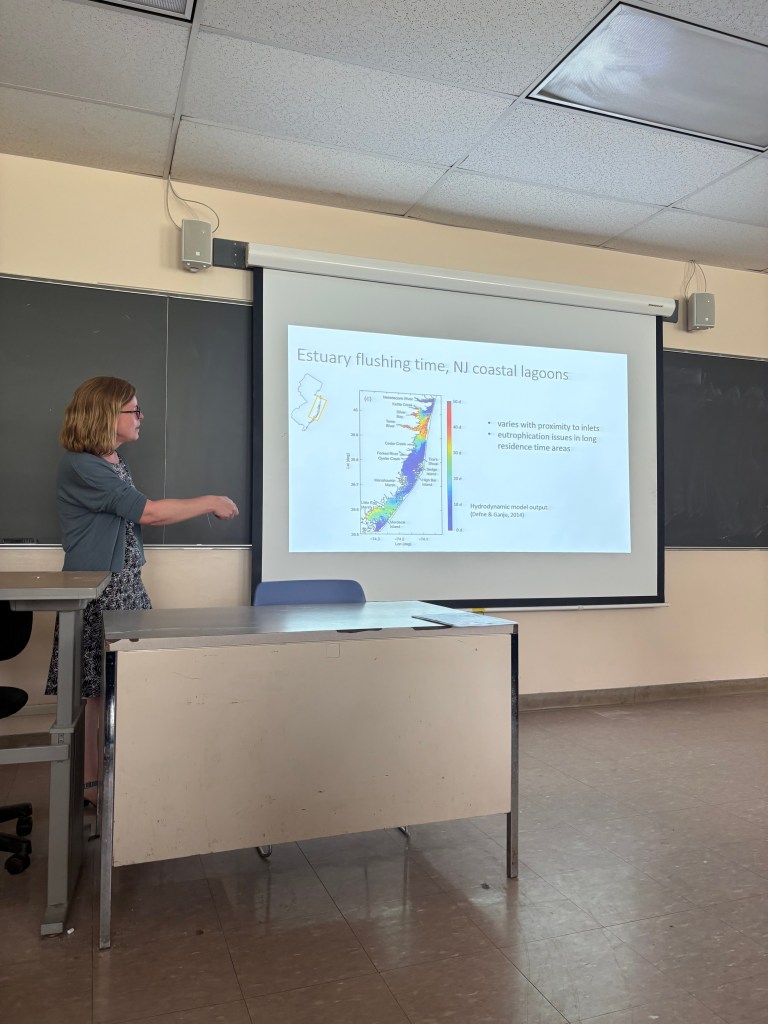
These bar-built estuarine landscapes in New Jersey have been suffering, with either having water flow or water getting stuck for a month or longer at a time, without the inlets being flushed out. Toms River, NJ, is one of the New Jersey towns that has the greatest suffering, with the inlets flushing in, struggling to flush out.
Anna Pfeiffer-Herbert is a scientist working on water flow in a bar built in New Jersey. She is trying to figure out why water gets stuck in estuaries and how to get it unstuck.
The barrier island system is a dynamic chain of mineral-rich sandy islands that stretches along the coast. This can be very helpful as a buffer against storms, but for New Jersey, it separates the island from the Atlantic Ocean.
By regulating the island’s tidal inlets to control the inflow and outflow of ocean water and sediments, officials maintain water salinity and clear out old, built-up water that hasn’t been cleared for more than 10 days.
There can be something as fast as flush rates, where water from estuaries comes in from all directions, mixes, and then flushes out to the ocean. But if it’s a slow flushing rate, estuaries can become filled with backed-up nutrients and pollutants that can harm humans. Such backups can last for days, weeks, or up to a month if they aren’t fixed.
“I enjoyed that she brought in her own work and her own pictures,” said Julia, a CSI student who attended the talk. “ It explained how the water has so many different, unique features, such as inlet flows, estuaries, and more.”
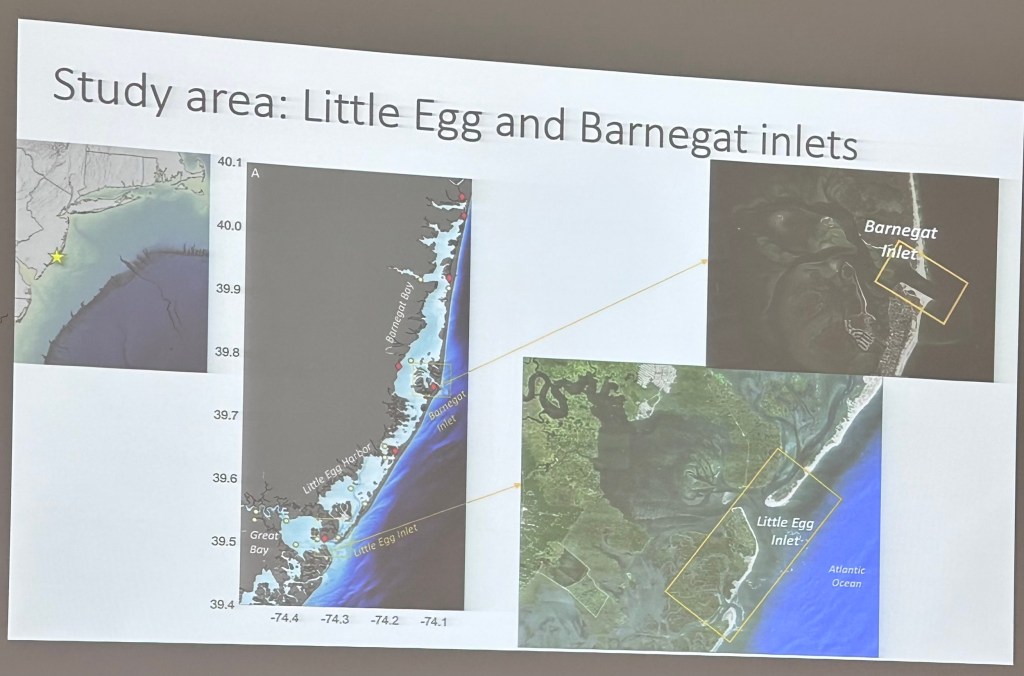
Pfeiffer-Herbert is conducing research on the Mullica River, which is part of the National Estuary Research Reserve. She is also doing work on Barnegat Bay, which is connected to the Mullica River and the Marville estuaries, with multiple inlets and a continental shift, including a small river.
By observing the inlets of Little Egg and Barnegat, Pfeiffer-Herbert aims to understand how cross-sections open and allow water n as part of studying inlet dynamics.
The estuaries are mainly groundwater-fed rather than river-fed. There are two different levels of saltwater, which is why the Department of Environmental Protection researchers are concerned for the animals that live off that water and are not getting those nutrients.
This movement of water not only transports nutrients, it actively reshapes the landscape. As patterns of deposition shift, sediment grain sizes change, making lasting alterations in the geological record.
“Looking at the ancient sediment, questioning the modern sediment,” said Pfeiffer-Herbert. “ It makes you think that everything we learned has been wrong due to grain size.”
Professor Pfeiffer-Herbert is showing that inlets at the end of New Jersey have had water stuck for more than 50 days since being flushed out, which has a huge impact on Toms River, NJ.
Truly, all comes back to the water supply and the inflows and outflows. This can cause a variety of sediments. The issue of New Jersey’s water flow may also impact Staten Island.
When asked if she was scared of AI taking over her job, Pfeiffer-Herbert revealed that scientists are working side by side with AI to collaborate. They utilize the technology for hard coding.
Pfeiffer-Herbert lectures a classroom of CSI students to discuss her research on the New Jersey Water flow with bar-built estuaries.
“As a scientist, I love to have my boundary pushed,” said Pfeiffer-Herbert. “ Especially seeing if AI can do my job, which I can’t.”